AWS Bill From $8,000 to $300 a Month on Bare Metal
By HissingKitty · October 31, 2026
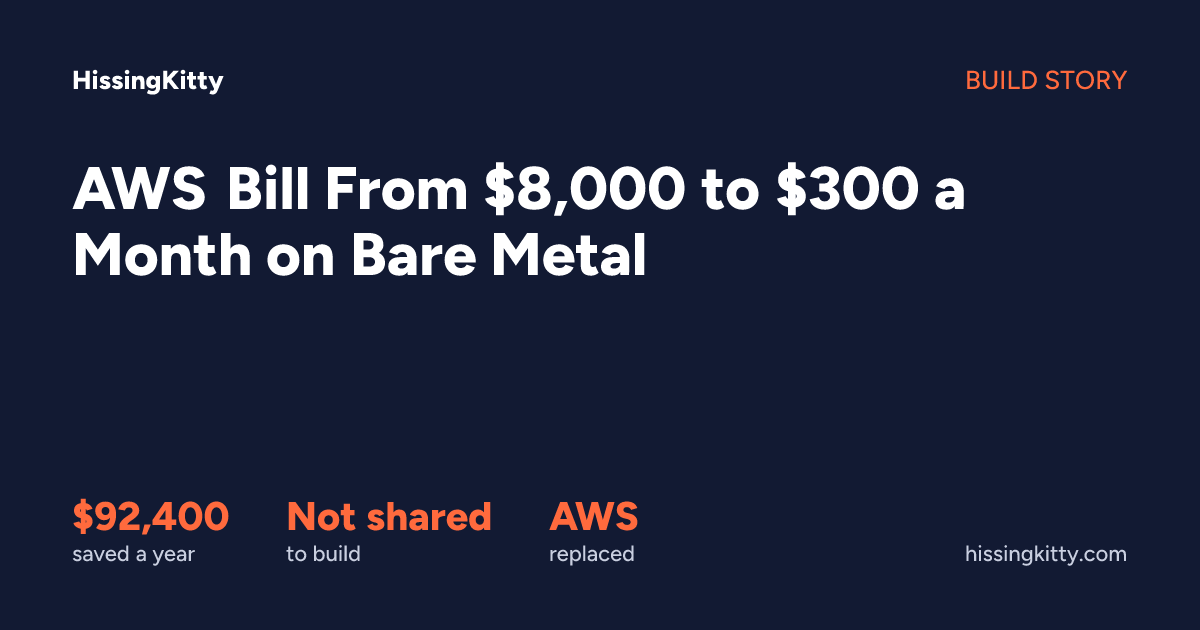
Simon Høiberg's company used to send AWS close to $8,000 every month. Today the whole company runs on three rented servers at Hetzner, and the bill is around $300 a month. That covers four SaaS products and more than 50,000 users.
The short answer to the headline: they stopped renting managed cloud services by the hour and started renting whole machines by the month. Our math puts the difference at about $7,700 a month, or roughly $92,400 a year, before counting the time it takes to run the servers themselves.
Key Facts
- **Before:** close to $8,000 a month on AWS (reported). - **After:** around $300 a month for 3 rented bare metal servers at Hetzner (reported). - **What runs on it:** 4 SaaS products, more than 50,000 users, with apps, databases, background jobs and monitoring (reported). - **Difference:** about $7,700 a month, about $92,400 a year (our math). - **New bill as a share of the old one:** about 4% (our math: $300 ÷ $8,000).
How Does an $8,000 AWS Bill Become $300?
AWS sells hundreds of managed services, and most of them bill by usage: compute hours, storage, database instances, data moving in and out. That is [usage-based pricing](/glossary/usage-based-pricing). It is great when you are small or your traffic swings. It gets expensive when your load is steady and you pay a premium every hour for flexibility you no longer use.
A rented bare metal server works the other way. You pay one flat monthly price for a whole machine, and you decide what runs on it. Høiberg put his apps, databases, background jobs and monitoring on three of them. He shared the before and after bills in [a public post on October 27, 2026](https://x.com/simonhoiberg/status/2115061274044248158), and every number in this story comes from that post or from simple math on it.
| | Before | After | |---|---|---| | Provider | AWS | Hetzner | | What you rent | Managed cloud services, billed by usage | 3 bare metal servers, flat monthly price | | Monthly bill | Close to $8,000 | Around $300 | | Runs | 4 SaaS products, 50,000+ users | The same 4 products and users |
You can see the flat monthly prices on [Hetzner's dedicated server page](https://www.hetzner.com/dedicated-rootserver/). AWS lists its usage pricing on the [AWS pricing page](https://aws.amazon.com/pricing/). On HissingKitty, [Hetzner](/listings/hetzner) is listed as one of the [AWS alternatives buyers compare](/vendors/aws).
What Does It Take to Run Your Own Servers?
The $300 is the server rent. It is not the whole cost of ownership. When you leave managed services, some work moves to your own team:
- Patching and upgrading the operating system and databases. - Backups, and testing that the backups actually restore. - Watching for failures, and being the person who gets the alert at 2 a.m. - Planning for a server dying, since three machines means each one matters.
Høiberg's post says monitoring is included in the setup. It doesn't say how many hours a month the team spends on upkeep. If it takes one engineer a few hours a week, the savings are still large. If it takes a full-time hire, much of the $92,400 goes to that salary.
What Does It Save?
Our math, using only the two reported bills:
- Monthly: $8,000 − $300 = $7,700. - Yearly: $7,700 × 12 = $92,400.
Both bills were described as "close to" and "around", so treat these as estimates. They don't include migration time or upkeep, because neither was shared. Our [methodology](/methodology) explains how we label reported numbers versus our own math.
Who Should Not Copy This?
This move fits a specific kind of company. Think twice if:
- Your traffic spikes hard and unpredictably. Usage pricing exists for exactly that. - You rely on AWS services with no simple self-hosted version, like managed machine learning or region-by-region failover. - Compliance rules require certifications or data locations your new host can't provide. - No one on the team wants to own servers. A cheaper bill that nobody maintains is a risk, not a saving.
For many teams the right answer is "Build part of it": move steady workloads like databases and background jobs to flat-priced servers, and keep the parts that truly need cloud elasticity.
What We Don't Know
- How long the migration took, and what it cost. - Which AWS services made up the old bill. - How many hours a month the servers take to maintain. - How the setup handles a server failing.
If Høiberg shares more, we will update this story.
Does This Apply to You?
- Can you name the five biggest lines on your AWS bill? - Is your traffic steady enough that you pay for idle capacity most of the month? - Does someone on the team want to own backups, patches and alerts? - Have you priced the hours, not just the servers?
If you answered yes to most of these, run your own numbers in the [Build vs. Buy estimator](/tools/build-vs-buy). And if you pay AWS today, [share what you pay](/review?vendor=aws). Every bill makes the comparison on the [AWS page](/vendors/aws) more useful for the next buyer.
Sources

AWS on HissingKitty
$5,050 /yr
Median of 6 teams
3.5
2 ratings
10
Alternatives listed
Built Something Like This?
List it free, or tell other teams what you pay today.