Breaches Are the Second Risk to Legacy SaaS
By Christine James, Editor · November 22, 2026
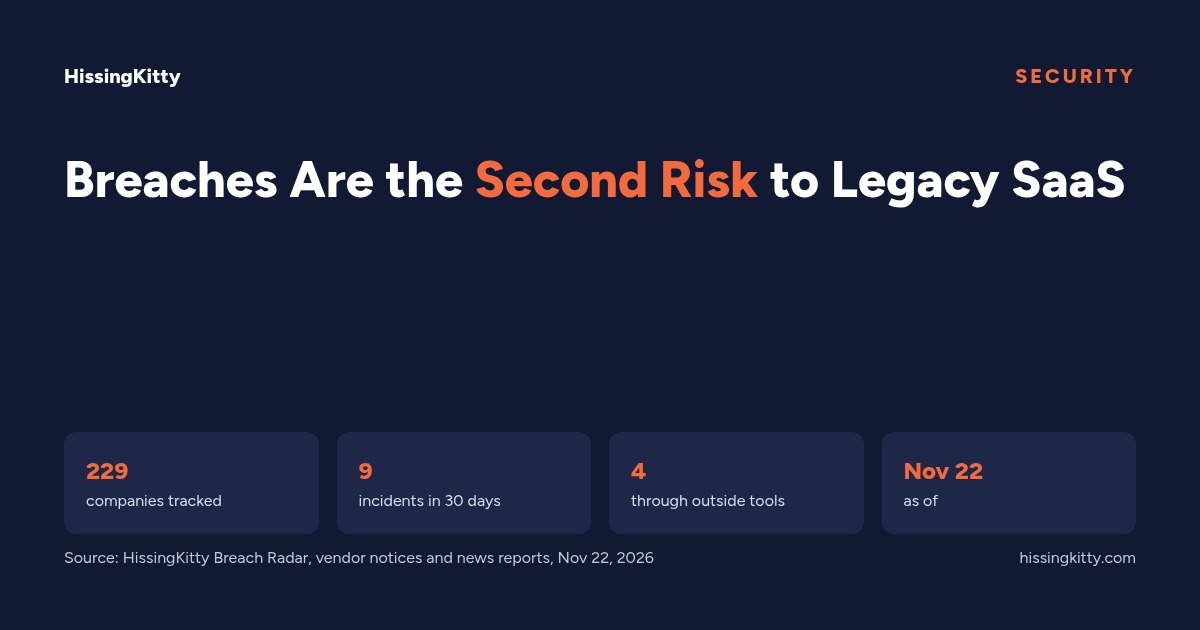
For two years the debate about legacy SaaS has been about AI. Teams can now build their own tools in days, and investors have marked down software companies because of it. Breach Radar now shows a second risk: the vendors people pay for safety are being breached, often through the apps and AI tools connected to them.
In the 30 days to November 22, 2026, 9 of the companies we track disclosed a confirmed security incident. Four of those came through an outside partner, app or AI tool. Every one is listed with its source on Breach Radar.
Key facts
- HissingKitty tracks 229 business software companies for confirmed security incidents.
- 9 confirmed incidents were disclosed in the 30 days to November 22, 2026.
- 4 of those 9 came through an outside partner, app or AI tool rather than the vendor's own systems.
- Optimizely reported harmful code placed in some customers' websites through its own platform (Nov 17 and 19).
- Shopify merchants' customer names, emails, phones, addresses and total spend were exposed through the Triple Whale app (Nov 20).
The First Risk Was AI
The "build your own" case has real examples. DocuSign quoted Kevin Rose's 15-person team $8,100 a year, so he built his own e-signature tool and open-sourced it. We covered it in Kevin Rose's DocuSign alternative. Other well-known builders have argued for owning your software for years.
The other side has a fair answer. People can cook, and restaurants still exist. Many teams would rather pay someone to run their data and their platform, and a big part of that payment is trust that the vendor will keep it safe.
Paying for Safety
Think of a $9 a month make-your-own burrito kit next to a restaurant that knows food safety. If the restaurants start making people sick, the premium needs a new reason.
Homegrown software gets hacked too. If both paths carry risk, the price difference has to be justified by something else, such as support, compliance work or features a team can't build.
What Breach Radar Shows
We count only confirmed incidents at tracked companies, dated by the vendor's disclosure. Records start August 22, 2026, so the early months are thin, and the rise in November partly reflects a newer search. Even so, November already has 8 incidents, and half of them came through a connected tool.
Half of November's Incidents Came Through a Connected Tool
Two this week stand out. Optimizely reported that an attacker placed harmful code in some customers' websites through its own platform, covered in our Optimizely story. Shopify merchants' customer details were exposed through the Triple Whale app, covered in our Triple Whale story.
Every Incident Since August 22
All 14 confirmed incidents we have logged, newest first. Each links to the vendor's own notice where one exists, otherwise to the news report it was confirmed from.
| Date | Company | Through | What was exposed | Source |
|---|---|---|---|---|
| Nov 20 | Shopify | Triple Whale app | Store customer names, emails, phones, addresses and total spend | GeekNative |
| Nov 19 | Optimizely | Own systems | Signup flaw used to plant code in customer projects (update) | Optimizely |
| Nov 17 | Optimizely | Own systems | Harmful JavaScript served to some customers' site visitors | BleepingComputer |
| Nov 13 | Bitrise | Own systems | Internal system reached; company says no customer data stored there | Bitrise |
| Nov 13 | Cursor | Fireworks AI | Coding agent traces from sessions not in Privacy Mode | Cursor |
| Nov 10 | Uber | Fireworks AI | Driver names, addresses, birth dates and license numbers | TechCrunch |
| Nov 8 | Notion | Fireworks AI | Notion AI chat transcripts from under 1% of workspaces | Notion |
| Nov 3 | GitBook | Own systems | API and integration tokens reachable for about 3.5 hours | GitBook |
| Oct 30 | Northflank | Own systems | Customer environment variables and secrets | Northflank |
| Oct 21 | Railway | Own systems | Environment variables, mainly AI provider keys, for at most 1.85% of workspaces | Railway |
| Oct 19 | Genesys | Own systems | Business contact and account details in internal systems | Genesys |
| Oct 17 | Microsoft | ConnectWise Cloud Backup | Stolen backup app login used to enter Microsoft 365 tenants | BleepingComputer |
| Oct 17 | OpenCode | Own systems | Saved AI provider keys for 1.4% of Console workspaces | The Hacker News |
| Aug 29 | Intercom | Canny app | Support data read with a stolen Canny access key | BTC-Echo |
How This Compares
6 of our 14 incidents (43%) came through an outside app, partner or AI tool. Verizon's 2026 Data Breach Investigations Report, which studied more than 22,000 breaches from 2025, found third-party involvement in 48% of breaches, up 60% from the year before. Our sample is tiny next to theirs, so the useful reading is that the two point the same way, not that the numbers match.
How We Count
- What counts: an incident the company confirmed, or that a named news outlet confirmed, where customer data or customer systems were reached. Unconfirmed hacker claims and patched flaws with no known use are left out.
- Who counts: only the 229 software companies we track, plus companies whose incident came through a tool we track. Most breaches each month hit companies outside that list.
- Dates: the day the company disclosed it, not the day the attack started.
- Coverage: a daily search started in mid October, and we searched back to August 22 once. Earlier months are likely undercounted, so month-to-month rises are not yet a trend.
What We Expect Over the Next Six Months
Our view, not a result
We expect confirmed incidents at tracked companies to keep rising through May 2027, mostly through connected apps and AI tools. We expect more buyers to raise security at renewal alongside price. Confidence: likely. We're wrong if monthly incidents on Breach Radar fall back below November's level for three months in a row.
If the build-your-own story already moved software valuations, a steady run of vendor breaches is a harder question for those companies to answer, because it goes to the reason many buyers chose them.
What to Ask Your Vendor Before Renewal
- Which outside apps and AI tools can reach our data, and how do you review them?
- Have you had a security incident in the last 12 months? Can we see the notice?
- How fast will you tell us, in writing, if our data is involved?
- Can we turn off connected apps we don't use?
- What changed in your price, and does any of it pay for security work?
Pair the answers with what others pay and recent hikes on Price Radar.
Where This Does Not Apply
Some tools are worth paying for even with this risk. Slack, Vanta and Drata stay "Keep paying" on our pages, and regulated data or teams with no technical owner usually belong with a vendor. A breach count is also not a ranking: a company that discloses quickly may be safer than one that says nothing.
Does This Apply to You?
- You have a renewal in the next 90 days: send the five questions now.
- You connect many apps or AI tools to one vendor: list them and remove the unused ones.
- You're weighing a custom build: run the numbers in the Build vs. Buy tool.
If a vendor's answer changes how you feel about them, say so in a review.
Built Something Like This?
List it free, or tell other teams what you pay today.